
How to Check Criminal History in Grand Haven
Start with the official office that created the Grand Haven record. The public-safety report describes the event and officer response. The jail roster can show present Ottawa County custody. The court register shows what prosecutors filed and how the case moved. Michigan State Police maintains a separate statewide repository product.
Use this five-part route for a focused Grand Haven records check:
- Request the police narrative from Grand Haven Department of Public Safety, using the incident number when known.
- Identify Police, Fire, Medical, or Accident on the city form so staff can route the request.
- Search 58th District Court-Grand Haven through MiCOURT for misdemeanors and felony preliminary events.
- Check the Ottawa County roster for current custody, then the 20th Circuit file if a felony was bound over.
- Use MSP ICHAT when a public statewide repository search is needed rather than one Grand Haven incident file.
Compare names, dates, locations, agencies, and case numbers across the results. Do not merge unlike products. An arrest allegation can change before filing, and a booking entry does not supply the disposition. A final court order is stronger evidence of outcome than an early police or jail label.
The Grand Haven Police Department
The Grand Haven Department of Public Safety is at 525 Washington Avenue, Grand Haven, MI 49417. Its main number is (616) 842-3460, fax is (616) 847-6050, and nonemergency dispatch is (800) 249-0911. Posted department hours are Monday through Friday, 8 a.m. to 5 p.m. Walk-ins are listed from 8 to 10 a.m., with appointment-only 30-minute blocks from 4 to 5 p.m.
The assigned Grand Haven image comes from the official Department of Public Safety source:
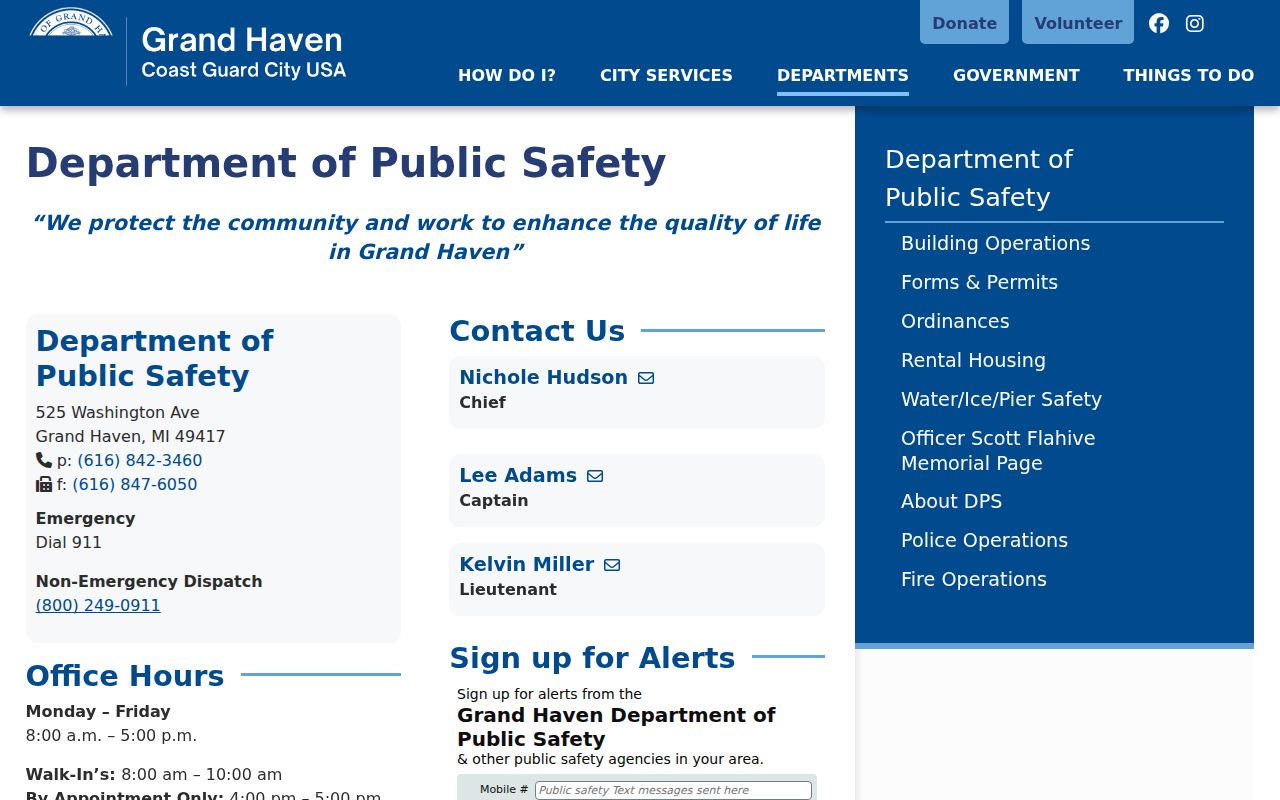
The image places the city record search at its true local starting point, where public-safety staff manage the source report rather than a commercial database.
Send the city form to GHDPSFOIA@grandhaven.org or deliver it to the Washington Avenue counter. Ask for the police narrative, photos, audio, video, or other components by name. Active investigations, juvenile and victim details, personal information, security material, and protected law-enforcement content may be redacted.
Grand Haven Record Response Clock
The city form states that Grand Haven will issue a written response within five business days. The agency may take a ten-business-day extension. Those periods describe the FOIA response decision, not a promise that every requested file will arrive in five days. A response may grant, deny, partly grant, seek clarification, estimate a fee, or invoke the extension allowed by law.
Plan the request around that distinction. Provide the incident number when available and spell out the wanted media. Email can document when the request was sent. If staff quote a fee or need clarification, answer promptly and retain the correspondence. Pickup or mail follows payment under the form's terms.
Payment options listed on the form include cash, money order, check, or credit card, with a convenience fee for card use. For a UD-10 crash report, the FY2025-26 schedule lists an $8 copy available in person only. Video and photographs remain priced under FOIA rather than that flat crash-copy line.
Arrests and Bookings in Grand Haven
Grand Haven officers create their own arrest and incident reports, but the city does not maintain a separate long-term jail. Continued detention occurs in the Ottawa County Jail at West Olive. This split leaves two official records: the GHDPS narrative and the Sheriff's booking or custody entry.
Search the current roster for a recent arrest and read the booking date, arresting agency, allegation, and bond as routing data. Then ask GHDPS for the source report if its officers made the arrest. If the person is no longer in custody, use the city request and MiCOURT rather than treating a blank live roster as proof that no arrest occurred.
Once charges are filed, the court record becomes the proper place to verify the authorized count and outcome. The police allegation, booking label, prosecutor's charge, and final judgment can differ. That is normal case movement, not necessarily a database mistake.
Grand Haven Records Workload in 2025
The department's 2025 annual report says four full-time and one part-time nonsworn staff managed Police, Fire, and Building records. Their work included FOIA, state crime, arrest and crash reporting, court records, and incident tracking. The system also integrates LEIN and NCIC functions, property lookup, sex-offender files, scanned case documents, and other operational material.
Staff handled 28,089 main-line calls, 313 FOIA requests, and 52 fingerprint services in 2025. These figures measure workload. They do not count convictions, and the main-line call total should not be labeled a crime total. A call may concern fire, medical aid, public service, traffic, or a noncriminal need.
The report helps explain why precise Grand Haven requests matter. Records staff work across several public-safety systems. A clear event date, location, incident type, and desired file component lets them identify the right source without guessing.
Grand Haven Municipal Court Records
The relevant local criminal court is not a city municipal court. It is the 58th District Court-Grand Haven, a Michigan state District Court branch at 414 Washington Avenue. Hours are Monday through Thursday, 8 a.m. to 5 p.m., and Friday, 9 a.m. to 5 p.m. The criminal division is (616) 846-8280, ghcrim@miottawa.org, and fax (616) 846-8291.
Misdemeanors remain in District Court. Felonies begin there for arraignment, probable-cause proceedings, and preliminary examination or waiver. A felony bound over for trial then moves to the 20th Circuit Court. MiCOURT provides the public search layer, but the clerk's official file controls.
| Court Name | 58th District Court-Grand Haven |
|---|---|
| Case Types Heard | Misdemeanors, ordinance and traffic matters, and preliminary felony stages |
| Case Lookup Channel | MiCOURT, with confirmation from the Grand Haven criminal desk |
| What the Docket Shows | Charge, hearings, register events, case status, disposition, and sentence data when public |
| Copies and Fees | Order from the clerk and confirm current copy or certification fees |
Grand Haven Police Narratives Versus Dockets
A GHDPS narrative and a MiCOURT docket answer different questions. The narrative may describe the call, officer observations, witness accounts, evidence, and the reason for an arrest. The docket records the judicial case: filed charges, hearings, pleas, motions, orders, disposition, and sentence.
Use the incident number to work with GHDPS and the case number to work with the court. If the report lists an arrest charge that is absent from the docket, check whether prosecutors declined it, amended it, or filed a different count. If MiCOURT shows only a preliminary felony phase, look for the linked 20th Circuit matter after bindover.
MiCOURT excludes sensitive cases and may apply a seven-year criminal-sentence filter for participating courts. Online entries are informational. The clerk can confirm an older Grand Haven file or explain a register entry that is unclear.
Where Grand Haven Records End Up
Grand Haven's integrated public-safety system sends required arrest and crime information into broader justice channels, but the source files remain distinct. GHDPS keeps the police report. Ottawa County keeps jail custody information. The prosecutor and courts create charge and disposition segments. Michigan State Police CJIC receives qualifying biometric, prosecutor, and final judicial data.
Record flow: Grand Haven Department of Public Safety › Ottawa County Courts › Michigan State Police Criminal Justice Information Center
ICHAT is the MSP public repository extract. It omits warrants, juvenile records, traffic records, federal and tribal matters, out-of-state events, suppressed entries, and some local misdemeanors. Use it for its statewide purpose, not as a substitute for the Grand Haven report or court file. The broader Ottawa County criminal history overview explains those county and state layers in more depth.
Grand Haven Festival Incident Records
Grand Haven sits at the mouth of the Grand River on Lake Michigan. Its compact downtown, waterfront, pier, US-31 traffic, Coast Guard City identity, and annual Coast Guard Festival create seasonal public-safety demands. Those local conditions can generate traffic, crowd, fire, medical, and service records alongside police incidents.
Do not assume every festival call is a criminal event. Mark the correct incident type on the shared form, give a precise place and time, and request the particular report. A dispatch entry may confirm a response without establishing an arrest. A police narrative can describe an investigation without proving a filed charge.
The July 1, 2025 Census estimate was 11,038 residents, and land area is 5.72 square miles. Those measures give local context but do not supply a crime rate. Use official case and report records for conclusions about a named incident.
Seasonal timing can still improve a request. Include the event name only as context, then supply the exact date, location, and incident type. Records staff need those concrete facts to distinguish a police response from fire, medical, traffic, or general service activity.
Public Access Rules
Grand Haven police and public-safety records are subject to Michigan FOIA when they are not exempt. Court records follow Michigan Court Rule 8.119 and clerk procedure. Criminal-history dissemination follows the Bureau of Criminal Identification Act. These systems protect some material even when another part of the same incident is public.
Key Statutes:
Michigan Freedom of Information Act, MCL 15.231-15.246 provides access to nonexempt public-body records and permits lawful redaction.
Bureau of Criminal Identification Act, MCL 28.242a governs public fingerprint-supported history and restricted repository information.
Michigan Court Rule 8.119 governs court-record access, restrictions, and management.
FOIA cannot compel Grand Haven to create an explanation or reveal sealed, juvenile, victim, private, or active-investigation data. Ask the court for judicial records and the city for its executive-agency records.
Grand Haven Criminal Records Desk
The Washington Avenue corridor places the public-safety office and District Court close together, but their files remain separate. Use 525 Washington Avenue for the GHDPS source report and 414 Washington Avenue for the court case. This simple address check keeps requests from circling between offices.
For a self-review, build a small record log with the incident number, police request date, court case number, roster date checked, and response status. Record what each source does not show. That makes it easier to spot a charge that changed, a disposition that has not yet reached a repository, or a custody entry that disappeared after release.
When a record appears wrong, begin with the office that created the disputed segment. GHDPS handles its arrest facts, the prosecutor handles its charge action, and the court handles its judicial result. Michigan State Police routes repository corrections back to those source agencies when needed.