
Criminal Cases in the Ottawa County Courts
The 58th District Court starts every Ottawa County criminal case. It conducts arraignments, handles bond, schedules pretrial work, and keeps misdemeanor prosecutions. A misdemeanor plea is taken there. A person charged with a felony does not enter a guilty or not-guilty plea at the District Court arraignment. The felony stays at that level through the preliminary examination, unless that hearing is waived. If the court finds probable cause, or the person waives examination, the matter is bound over. Bindover means transfer to the Circuit Court for the felony prosecution.
The 20th Circuit Court Trial Division hears the bound-over capital and non-capital felonies. The Ottawa County Clerk maintains the Circuit Court criminal file. The Grand Haven courthouse holds the Circuit Records counter and the Grand Haven District branch, yet it is not the only District location. Holland and Hudsonville have separate criminal desks. A name match should therefore be tied to the court, branch, case number, and stage before anyone treats it as the right Ottawa County case.
Ottawa Felony Cases Cross Two Courts
A common search mistake is to expect one continuous Ottawa County felony number. District Court creates the first record because all criminal cases start there. After bindover, Circuit Court creates the felony-level record. The two dockets describe different parts of the same prosecution. The District file can show arraignment, bond, preliminary-examination events, and the transfer. The Circuit file can show the information, pleas, motions, trial events, judgment, and sentence.
When one search result seems to stop after a preliminary event, check whether the docket records a waiver or bindover. Then search the Circuit side using the participant’s name, year, and related case details. The filed charge may also differ from the first arrest allegation. For a full Ottawa County court history, read both files in order and ask each clerk about records held only at that level.
Case route: Charges Filed › Arraignment › Pretrial › Plea or Trial › Disposition › Sentencing
How to Search Case Records
The statewide MiCOURT Case Search is the first index for participating Michigan trial courts. Search by participant name or case number, choose the Ottawa County court, and use criminal, year, status, judge, or filing-date filters where available. The index is informational. It does not replace the clerk’s official file, and the county does not promise that public MiCOURT provides downloadable pleading PDFs.
- Choose the Ottawa Circuit or District court that may hold the case.
- Search by case number when known. Otherwise, enter the participant’s first and last name.
- Narrow the result with criminal category, case year, public status, judge, or filing dates.
- Read the court, case number, status, charges, next hearing, and docket events together.
- Contact the correct Ottawa County criminal desk for missing entries, older records, copies, or certification.
| Field or control | Type | Required | Options or notes |
|---|---|---|---|
| Court | Selector | For court search | Choose a participating Circuit or District court |
| Case Number | Text | One route | Partial matching is documented |
| First and Last Name | Text | Name route | Participant-prefix matching is documented |
| Case Type Category | Filter | No | Includes criminal, non-traffic, traffic, and other categories |
| Case Year | Filter | No | Four-digit year |
| Case Status | Filter | No | Open, closed, deferred, disposed, and other listed states |
| Public Status | Filter | No | Public or suppressed |
| Judge and Filing Dates | Filters | No | Assigned judge and a filing-date range |
MiCOURT Limits on Ottawa Cases
The official MiCOURT terms for the Ottawa court explain why a public search can miss a valid record. Some participating courts apply a seven-year criminal-sentence filter. Sensitive case types do not display, restricted information is suppressed, and bulk downloads are barred. An older Ottawa County criminal case may still exist at the clerk even when the public index returns no result. Contact the trial court instead of treating silence as proof that no file exists.
The judiciary also posts a specific warning for attempts charged under MCL 750.92. The public display may label an attempted felony as “FELONY” even when subsection (3) makes that attempt a misdemeanor. Read the statute and the filed charging document, or ask the clerk to confirm the level. The official MiCOURT search screen shown here is the right place to begin, but the source court settles any conflict.
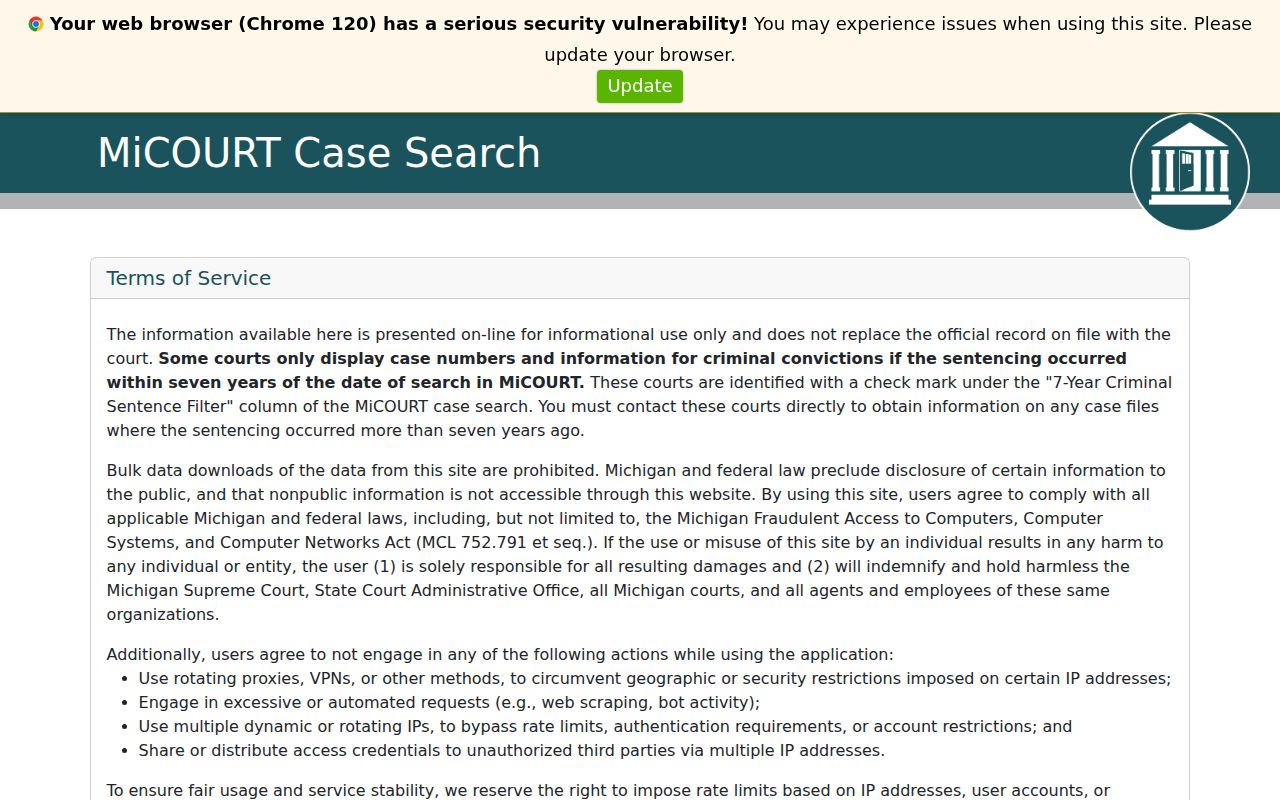
The court selector and search controls help route a query before the Ottawa County clerk verifies the record.
What the Case File Shows
A criminal file is more than a result line. It can connect the charge as filed to each court event and final action. Judiciary documentation describes expandable resources such as the case identifier, year and type, status, assigned judge, participants, charges, next hearing, petitions, prosecutor, and referee. A public schedule can show the party name, hearing time, room, and case number. Not every field appears in every Ottawa County public result, and protected details remain hidden.
| Case Number and Court | Identifies the docket and whether District or Circuit Court owns that stage. |
|---|---|
| Charging Document | The complaint starts the charge; an information states the bound-over felony charge in Circuit Court. |
| Docket Entries | The register of actions lists filings, hearings, orders, pleas, and other events by date. |
| Hearing Dates | Shows scheduled and completed events, subject to later court changes. |
| Disposition and Judgment | Records an outcome such as conviction, dismissal, acquittal, or nolle prosequi. |
| Sentence and Conditions | May state custody, probation, fines, costs, restitution, and other terms ordered. |
The filed court record controls. An arrest entry can use an initial allegation, while the Ottawa County docket shows what the prosecutor filed and how the court resolved it.
Ottawa County Criminal Case Terms
Short docket labels can change the meaning of a search result. “Disposition” is the result of a charge, not merely the close of a hearing. “Nolle prosequi” records a prosecutor’s decision not to continue a charge. An acquittal is a not-guilty decision. A dismissal ends the charge without a conviction on it. A set-aside makes an eligible conviction and related record nonpublic under Michigan law, subject to statutory exceptions.
- Preliminary examination
- A District Court hearing that tests probable cause on a felony.
- Bindover
- The felony’s transfer to Circuit Court after probable cause or waiver.
- Register of actions
- The dated court list of filings, hearings, orders, and outcomes.
- Disposition
- The result of the charge, such as conviction, dismissal, or acquittal.
- Sentence
- The consequences ordered after conviction, which may include custody or supervision.
Michigan also uses statute-specific deferral and dismissal paths, including HYTA, MCL 333.7411, and MCL 769.4a. Do not force those entries into another state’s “deferred adjudication” label. Read the cited statute and the Ottawa County order.
Stages of a Criminal Case
The 58th District Court explains charges and maximum penalties at arraignment, advises the person of rights, and addresses release. District judges or magistrates set bond based in part on the chance of appearance and risk to a victim or the community. The official court description says misdemeanor pretrial conferences are normally set within 30 days. A misdemeanor then moves toward plea, trial, disposition, and any sentence at District Court.
A felony follows a different track. The District Court holds the preliminary examination or records its waiver. After bindover, the 20th Circuit Court handles the felony plea, motion practice, trial, judgment, and sentence. Each stage adds a dated docket event. The sequence, rather than one isolated status word, shows where the Ottawa County criminal case stands.
Ottawa County Criminal Records Counter
For a Circuit case, the Circuit Court Records Division is the authoritative counter. It is in Room 320 at 414 Washington Avenue, Grand Haven, and is open Monday through Friday from 8:00 a.m. to 5:00 p.m. Call (616) 846-8315 or email CircuitCourtRecords@miOttawa.org. Machine copies cost $1 per page. A certified copy costs $10 plus $1 per page, and the office does not accept personal checks.
District requests go to the branch that handled the case. Grand Haven is at 414 Washington Avenue, (616) 846-8280, ghcrim@miottawa.org. Holland is at 85 West 8th Street, (616) 392-6991, holcrim@miottawa.org. Hudsonville is at 3100 Port Sheldon Road, (616) 662-3100, hudcrim@miottawa.org. Each District branch is open Monday through Thursday from 8:00 a.m. to 5:00 p.m. and Friday from 9:00 a.m. to 5:00 p.m.
Circuit Court Records
414 Washington Avenue, Room 320
Grand Haven, MI 49417
(616) 846-8315
Monday-Friday, 8:00 a.m.-5:00 p.m.
Access & Restrictions
Michigan Court Rule 8.119 governs court-record inspection, restrictions, and management. Court access is not the same as an executive-agency request under the Michigan Freedom of Information Act. The clerk applies court rules and statutes to the judicial file. Juvenile and child-protective proceedings, suppressed cases, sealed or set-aside records, victim details, and other protected data can be absent or redacted.
The Bureau of Criminal Identification Act governs criminal-history dissemination, while the Setting Aside Convictions Act controls application-based and automatic relief. An ICHAT result is a public state repository extract. It is not the same document as the Ottawa County case file. When a record is missing, ask the clerk whether the problem is an older-case filter, the wrong court level, a restriction, or an incomplete name search.
Note: The official Ottawa County clerk file, not the public search summary, controls the case record and certified outcome.
Ottawa County Treatment Court Dockets
Not every Ottawa County criminal docket follows only the standard plea-or-trial track. The county’s 2025 Prosecutor report identifies four District and Circuit Sobriety or Recovery Court programs for drug and alcohol dependency, plus Holland Mental Health Court. A prosecutor serves on each multidisciplinary team. The teams select participants and monitor progress through biweekly staffing and court sessions. These programs can create docket events tied to screening, admission, reviews, compliance, and completion.
The 20th Circuit Recovery Court is based at 414 Washington Street, Suite 300, Grand Haven, and its contact number is (616) 846-8352. Program participation does not erase the need to read the filed charge and disposition. It adds context to how the Ottawa County case moved. The separate MiCOURT court view and terms shown in the official capture also reinforce that public data has filters and limits.
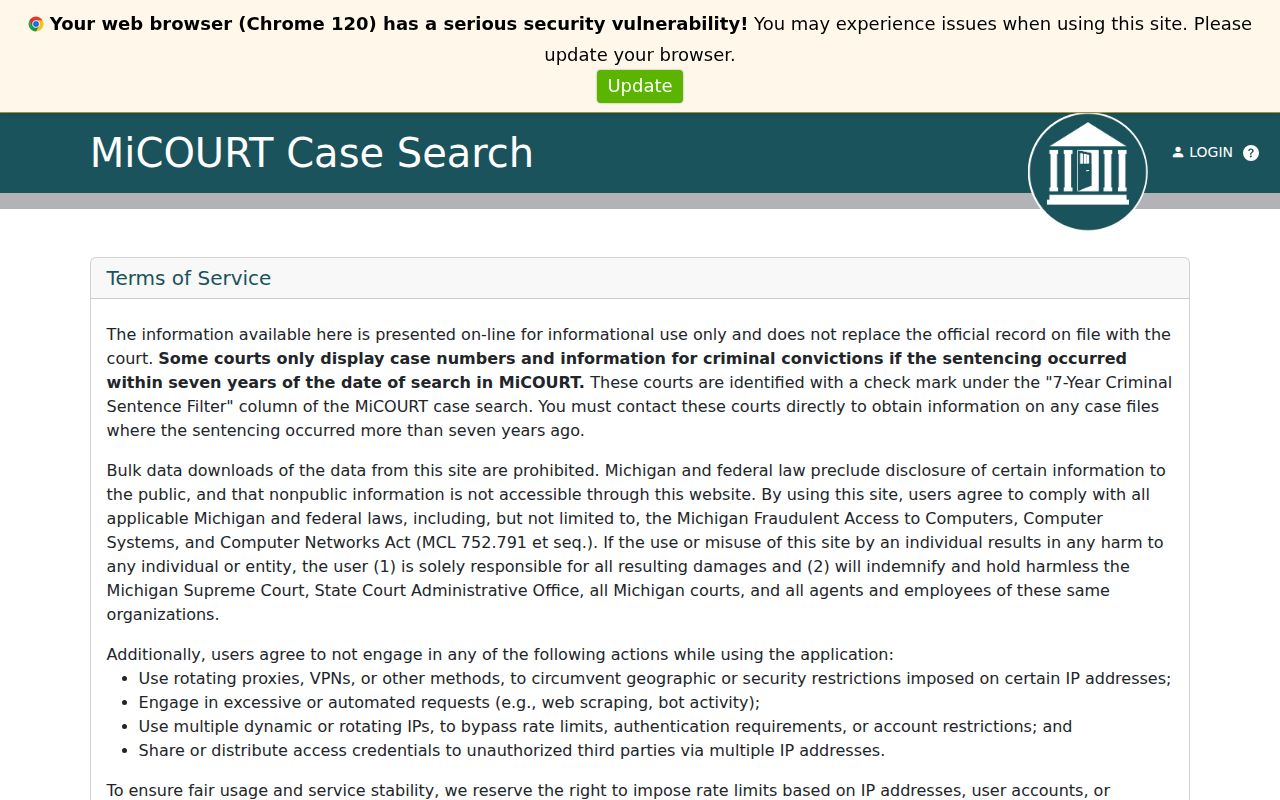
Those limits make clerk verification vital when a treatment-court event or older Ottawa County criminal record does not appear online.